
How long has your IT support team been measuring customer satisfaction (CSAT) with respect to its end users? How long has it been scoring highly? And how long have you felt that your organization’s employees – or external customers if you’re a managed service provider (MSP) – aren’t as happy with your IT service delivery and support as the CSAT scores suggest? Don’t worry about the latter though – because, while it might feel as though it’s a bad thing, it’s actually a good thing. You’ve taken the first step in questioning the value of CSAT questionnaires for IT support and realizing that improvements might be necessary to better meet business and employee needs. This blog explains how employee experience management will help. The moving customer-satisfaction goalposts of IT support While the above concern – about the accuracy and value of CSAT questionnaires – is important, so is the recognition that employee expectations of IT support have changed, and continue to change. An element of this is the importance of IT services and support to employees being able to do what they need to do at work – with IT issues ultimately employee issues and potentially business issues. However, there’s also the growing employee expectations of service, support, and customer service that are being driven by their consumer-world experiences. Where, outside of work, their business-to-consumer (B2C) service and support experiences are being elevated by suppliers investing in customer experience (CX) strategies in the war to win, retain, and grow customers. Then, as with the now-aged “consumerization of IT,” employees are bringing these elevated expectations into the workplace. As a result, IT support teams need to get closer to employees’ personal-life service and support experiences (within the operational limits placed on the IT support organization), and this will only be dialed up further as the B2C company CX investments continue. Looking to employee experience management as a driver for IT support improvement Employee experience is a growing trend for IT organizations. The results of the ITSM.tools 2019 Future of IT service management (ITSM) survey showed that half of the respondents think that employee experience is already important to their IT organization and another quarter believe it will be by 2021. The importance of employee experience is also reflected in IT support industry surveys. For example, Service Desk Institute (SDI) survey data shows that UK and European service desks are now focused on employee experience over everything, including budgets (both SDI and HDI have a policy of referring to end users as the customers of the service desk): “Please rank these in terms of their influence on the service desk strategy” 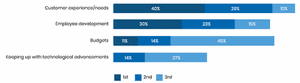 Source: SDI, “The State of Service Desk Strategy” (2019) Plus, it’s also top-ranking in total for top-3 picks at 79%. Another example, this time from a North American focused survey, is HDI data – from the 2018 Practices & Salary Report – that shows “improving the employee experience” as the top factor in motivating new technology implementations and upgrades. At 71%, this is ahead of continual process improvement at 59%, business alignment at 46%, and cost at 44%. So, employee experience is important – but what is it? As with many new terms, a quick search of the Internet brings back a variety of definitions that seem to be more about showing how smart the author is, rather than helping the reader. So, when researching on employee experience, be prepared for definitions such as this one from McKinsey: “…companies and their people working together to create personalized, authentic experiences that ignite passion and tap into purpose to strengthen individual, team, and company performance.” It’s not likely to inspire change in your average IT support team. Whereas a more practical definition of employee experience, such as the following from Forrester, is probably easier to consume and to sell on to others: “Psychological research shows that the most important factor for employee experience is being able to make progress every day toward the work that they believe is most important.” There are also many online explanations as to the difference between CSAT and customer experience (rather than employee experience). These commonly relate to factors such as timing, focus, and feelings. However, a smarter way to consider the difference is to appreciate the additional insight employee experience feedback can provide. Using employee experience data to drive IT support improvement HappySignals is an example of a provider of IT-support-related employee experience data and services that shares the aggregated results of its customer employee experience feedback scores on their website. For instance, the image below shows the feedback differences between various IT support contact channels:
 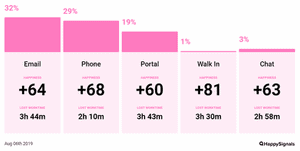 With HappySignals, employees provide feedback on two key facets of their IT-support employee experience: their happiness and level of lost productivity. The above channel-based view shows that – based on over 294 thousand pieces of employee feedback in the last six months – the IT self-service portal channel provides the worst employee experience (where happiness = +60) and also causes the highest level of employee lost productivity at 3.75 hours along with the email channel). It’s therefore not showing the expected speed and employee experience improvements and is likely to be struggling with the anticipated cost savings too. It’s therefore not showing the expected speed and employee experience improvements and is likely to be struggling with the anticipated cost savings too. In terms of the data and feedback that’s captured behind these high-level metrics, at the end of 2018 the top three contributing factors for employee happiness were:
- Speed of service
- Service personnel’s attitude
- Service personnel’s skills.
Whereas unhappy employees highlighted:
- Slowness of service
- Their issue not being solved despite ticket closure
- Having to reexplain the issue and provide details repeatedly, i.e. being bounced between people.
Ask yourself, would you get this insight into issues and improvement opportunities from your current customer satisfaction feedback mechanism (that probably shows a 95% level of satisfaction from the small minority of employees that chose to respond)? Lost productivity reduction – the “killer app” for employee experience While it’s easy to think of employee experience as being a mechanism for IT support teams to “keep up with the B2C Joneses,” there’s more to it than simply providing better quality service and support. For example, consider the many cost-cutting strategies we see in the IT support industry – how do we know that saving US$1 in support costs isn’t costing the parent organization US$10 or more at a business level thanks to increased employee lost productivity? Plus, HappySignals has proven a link between employee happiness and productivity (when it comes to IT support). It’s now a big business case element for HappySignals customers, who are reducing employee lost productivity levels by focusing on improving employee happiness. And with such data, and improvement results, being shared by companies such as HappySignals, the popularity and perceived value of employee experience management can only grow. Do you currently measure your employee experience? If so, how has it helped your IT support capabilities? Please let me know in the comments.